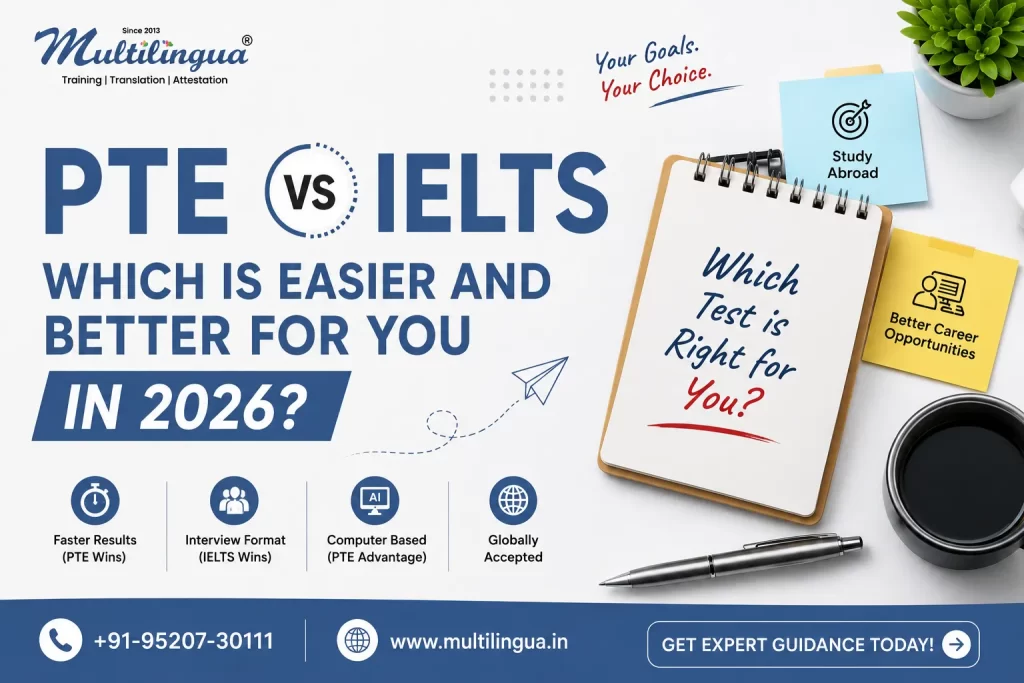
Every year, thousands of students preparing to study abroad or migrate face the same decision: PTE or IELTS? Both are among the most widely recognized English proficiency tests, accepted by universities, employers, and immigration authorities across Canada, Australia, the UK, and beyond.
But “easier” is not the same for every student. A test that feels straightforward to someone comfortable with computers and typing might feel unfamiliar to someone who prefers speaking face-to-face. Your ideal choice depends on your English proficiency level, test-taking style, target score, destination country, and preparation timeline.
This guide breaks down PTE and IELTS in detail, comparing format, difficulty, scoring, and country-specific requirements, so you can make an informed decision rather than guessing. If you’re exploring PTE preparation in Delhi or comparing coaching options, you’ll also find practical guidance on choosing the right institute later in this article.
PTE vs IELTS at a Glance
| Feature | PTE Academic | IELTS |
|---|---|---|
| Test Format | Fully computer-based | Paper-based or computer-delivered, depending on test center |
| Test Duration | Approximately 2 hours | Approximately 2 hours 45 minutes (including speaking) |
| Speaking Format | Recorded responses spoken into a microphone | Face-to-face or video-call interview with a certified examiner |
| Listening | Integrated with other skills; computer-scored | Standalone section with varied accents |
| Reading | Computer-based, multiple task types | Computer or paper-based, multiple task types |
| Writing | Typed responses, computer-scored | Handwritten or typed, human-scored |
| Scoring System | Automated (AI-based) scoring | Human examiner scoring |
| Results Turnaround | Typically faster (often within a couple of days) | Typically takes a few days longer, depending on test type |
| Test Delivery | Test center, fully computerized | Test center, with format options depending on location |
| Human vs Computer Interaction | Minimal human interaction during the test | Direct human interaction in the speaking module |
| Best Suited For | Candidates comfortable with typing and computer-based tasks | Candidates who prefer traditional, interactive test formats |
What Is PTE Academic?
PTE Academic (Pearson Test of English Academic) is a fully computer-based English proficiency test. Every section, listening, reading, writing, and speaking, is completed on a computer, and your speaking responses are recorded and evaluated using automated scoring technology.
How it works: You sit at a computer workstation with a headset and microphone. Questions are presented on screen, and most tasks combine two skills at once, such as “read aloud” (reading plus speaking) or “summarize spoken text” (listening plus writing). This integrated-skills format is one of PTE’s defining features.
Speaking and listening environment: Because responses are recorded rather than spoken to a person, some candidates find this less intimidating, while others miss the natural back-and-forth of a conversation.
Scoring approach: PTE uses AI-based scoring, which many candidates find more consistent and less subjective than human evaluation, though it also means the system is strict about pronunciation, fluency, and task completion patterns.
Who may benefit from PTE: Candidates who are comfortable typing, prefer structured computer-based tasks, and want faster results often gravitate toward PTE. If you’re researching PTE or IELTS preparation in Delhi, understanding this computer-first format is the first step before choosing a coaching program, since your practice routine should closely mirror the actual test environment.
What Is IELTS?
IELTS (International English Language Testing System) is jointly managed by the British Council, IDP, and Cambridge Assessment English. It comes in two versions:
- IELTS Academic: For students applying to universities and higher education institutions.
- IELTS General Training: For migration, work, and secondary education purposes.
Listening: A standalone section featuring a range of native English accents.
Reading: Passage-based questions that differ in content between Academic and General Training versions.
Writing: Involves two tasks, often completed by hand at paper-based centers, though computer-delivered options exist at many locations.
Speaking: A face-to-face or video interview with a certified IELTS examiner, structured in three parts, covering general questions, a individual long turn, and a two-way discussion.
Band scoring: IELTS uses a 9-band scoring system, with human examiners assessing writing and speaking.
Human interaction: The direct conversation with an examiner is IELTS’s most distinctive feature. Candidates who communicate well in natural conversation, and who may feel that automated scoring doesn’t capture their fluency, often prefer this format.
Who may prefer IELTS: Those who are confident speaking with another person, comfortable with a traditional test structure, or who need IELTS specifically for a university, employer, or immigration requirement.
PTE vs IELTS: Which Is Easier?
There’s no universal answer here. Difficulty depends heavily on individual strengths. Here’s a balanced, skill-by-skill breakdown:
Speaking: PTE may feel easier for candidates who get nervous speaking to another person, since you’re speaking into a microphone alone. IELTS may feel easier for candidates who think better in conversation and benefit from an examiner’s prompts and follow-up questions.
Writing: PTE’s writing tasks are typed and scored by AI, rewarding precise grammar, structure, and task completion. IELTS writing is evaluated by a human examiner, who may better appreciate nuanced arguments, but also expects strong handwriting clarity (at paper-based centers) and coherent essay structure.
Reading: Both tests assess vocabulary and comprehension similarly, though PTE’s reading tasks are more tightly integrated with other skills, while IELTS reading is a standalone section with generally more traditional question types.
Listening: IELTS listening features a wider variety of accents in a dedicated section. PTE listening tasks are shorter but interspersed throughout the test, which some find more manageable and others find more disorienting.
Grammar and vocabulary: Both tests reward strong, accurate English. Neither test can be “gamed” without genuine language competence.
Typing and computer skills: This is where the two tests diverge most. PTE requires comfortable, accurate typing under time pressure. Candidates who type slowly or make frequent typos may find this section challenging regardless of their English ability.
Anxiety and test environment: Some candidates feel calmer without a live examiner watching them; others find the silence and microphone-only format of PTE more stressful than a natural conversation.
Example: A student who prefers speaking into a microphone and typing quickly may feel more comfortable with PTE, while someone who prefers face-to-face speaking interaction and traditional essay writing may prefer IELTS.
PTE vs IELTS Score Comparison
The table below offers an indicative, general comparison often referenced by test-takers and institutions. This is not an official conversion chart, and it should not be treated as a guarantee.
| PTE Score (Indicative) | IELTS Band (Indicative) |
|---|---|
| 85-90 | 8.5-9.0 |
| 76-84 | 7.5-8.0 |
| 65-75 | 7.0 |
| 59-64 | 6.5 |
| 50-58 | 6.0 |
| 43-49 | 5.5 |
Important: Score conversions vary between institutions, and not every university or immigration authority uses the same equivalency table. Some may accept PTE but not IELTS General Training for a specific pathway, or vice versa. Always check the specific score requirement directly with your target university, employer, or the relevant immigration authority before relying on any conversion chart.
PTE vs IELTS for Canada
Both PTE and IELTS are accepted by many Canadian institutions, but acceptance and score requirements depend heavily on the specific pathway:
Study permits and university admission: Canadian universities and colleges set their own minimum English proficiency requirements, and not every institution accepts both tests for every program.
Express Entry and immigration pathways: For federal economic immigration programs, IRCC has historically designated specific English tests, and PTE Core and IELTS General Training are among options considered for certain programs, subject to change.
Provincial programs: Provincial Nominee Programs (PNPs) may have their own English test requirements, which can differ from federal requirements.
Because these requirements change and vary by pathway, do not assume blanket eligibility. Always verify current requirements directly on the official IRCC website or with the relevant provincial program before choosing a test.
PTE vs IELTS for Australia
Study abroad: Australian universities generally accept both PTE Academic and IELTS Academic, but individual score thresholds vary by institution and course.
Skilled migration: The Department of Home Affairs recognizes multiple English tests for skilled visa categories, and required scores differ by visa subclass and points-testing needs.
Test acceptance differences: Some visa categories or institutions may have specific test or score preferences, so it’s worth confirming before you commit to a preparation path.
Always check the current Department of Home Affairs guidelines and your target university’s official admissions page, since requirements are updated periodically.
PTE vs IELTS for Study Abroad
When comparing exams for study abroad, weigh these factors together rather than picking based on difficulty alone:
- Target country: Some destinations favor one test over another for specific visa categories.
- University requirements: Confirm which test (and minimum score) your target university accepts.
- Required score: Match the test to the score band you’re realistically likely to achieve within your timeline.
- Application deadlines: Faster results turnaround can matter if you’re working against a tight deadline.
- Test availability: Check test center locations and available dates near you.
- Personal strengths: Choose the format (computer-based vs. human interaction) that plays to your natural strengths.
- Retake options: Understand each test’s retake policy and cost before your first attempt.
Which Test Is Better for You?
Choose PTE if you:
- Prefer computer-based testing over face-to-face interaction
- Type comfortably and quickly
- Like structured, consistent computer scoring
- Prefer not to have a live speaking interview
- Are comfortable with integrated, multi-skill tasks
Choose IELTS if you:
- Prefer speaking directly with another person
- Are comfortable with the test’s writing format, handwritten or typed
- Prefer a traditional, well-established test structure
- Need IELTS specifically for a particular immigration or institutional requirement
Neither exam is universally better. The right choice depends on your target destination’s accepted tests, your personal comfort with the format, and the score you need to achieve.
PTE Preparation in Delhi: What Should You Look For?
If you’ve decided PTE suits your goals, choosing the right preparation path matters as much as the decision itself. When evaluating PTE preparation in Delhi, look for:
- Experienced trainers familiar with the current PTE format and scoring criteria
- Updated syllabus that reflects recent test changes
- Full-length mock tests under real exam conditions
- Detailed speaking feedback on pronunciation, fluency, and pacing
- Structured writing evaluation with actionable corrections
- Computer-based practice sessions, since familiarity with the interface matters
- Individual performance analysis rather than generic group feedback
- Small batch sizes for more personalized attention
- Flexible timings that fit around work or college schedules
- Comprehensive study materials covering all four skills
- Doubt-solving sessions for ongoing queries
- Transparent fee structures with no hidden charges
PTE Coaching in South Delhi: How to Choose the Right Institute
If you’re specifically comparing PTE coaching in South Delhi, use this practical checklist before enrolling:
- Trainer credentials: Ask about trainers’ certification and years of PTE-specific teaching experience.
- Demo class: Attend a trial session before committing to a full course.
- Student reviews: Look for consistent, verifiable feedback rather than a handful of testimonials.
- Mock-test quality: Confirm mock tests replicate the real exam interface and timing.
- Batch size: Smaller batches generally allow more individual attention.
- Personalized feedback: Ask how feedback is delivered, written reports, one-on-one sessions, or both.
- Course duration: Match the course length to your target test date and current level.
- Online/offline options: Choose the format that fits your schedule and learning style.
- Location and accessibility: Convenient location matters for regular in-person practice.
- Transparent pricing: Get a clear breakdown of fees before enrolling.
- Performance tracking: Look for institutes that track your progress across mock tests over time.
No institute can guarantee a specific score, since results depend on individual effort, baseline proficiency, and consistent practice. Be cautious of any coaching center that promises guaranteed scores.
How Long Does PTE Preparation Take?
Preparation timelines vary significantly based on your starting point:
- Beginner to intermediate English level: Often needs 8-12 weeks of consistent preparation to build both language skills and test familiarity.
- Strong English foundation: May need 3-6 weeks focused primarily on test strategy and format familiarity.
- Targeting a moderate score: Generally requires steady practice across all four skills with regular mock tests.
- Targeting a high score: Typically requires more intensive, sustained practice, particularly on pronunciation, fluency, and precise task completion.
These are general guidelines, not fixed rules. Actual timelines depend on your baseline proficiency, target score, daily practice hours, and whether you’ve taken the test before.
Common PTE Preparation Mistakes
Avoid these frequent errors that slow down progress:
- Memorizing templates without understanding the underlying task, which often backfires since PTE’s AI scoring detects unnatural, formulaic responses
- Ignoring pronunciation practice, a critical factor in speaking scores
- Not practicing typing speed and accuracy, which affects writing and several integrated tasks
- Avoiding full-length mock tests, which are essential for building stamina and pacing
- Failing to analyze mistakes after each practice session
- Practicing only one skill instead of balancing all four
- Using outdated preparation material that doesn’t reflect current test patterns
- Assuming one strategy works for everyone, when in fact preparation should be tailored to individual strengths and weaknesses
PTE vs IELTS: Final Verdict for 2026
There is no single “better” test between PTE and IELTS. PTE may suit computer-comfortable candidates who prefer structured, automated scoring and faster results. IELTS may suit candidates who communicate confidently in face-to-face conversation and prefer a traditional test format.
Before choosing either exam, prioritize your destination country’s and target institution’s accepted tests and score requirements. Once you’ve confirmed eligibility, let your personal strengths, typing speed versus conversational confidence, comfort with computers, and preferred test environment guide your final decision.
Quick Answers
Is PTE easier than IELTS?
Neither test is universally easier. PTE may feel easier for candidates comfortable with typing and computer-based tasks, while IELTS may feel easier for those who prefer speaking directly with an examiner. Difficulty depends on individual strengths.
Which is better, PTE or IELTS?
Neither is inherently better. The right choice depends on which test your target university, employer, or immigration authority accepts, along with your personal comfort with computer-based versus face-to-face formats.
Is PTE accepted for Canada?
PTE is accepted by many Canadian institutions and, depending on the pathway, may be recognized for certain immigration programs. Requirements vary and should be verified with IRCC or your target institution.
Which is better for Australia, PTE or IELTS?
Both PTE Academic and IELTS Academic are accepted by many Australian universities and considered for various visa categories. Acceptance and required scores vary by institution and visa subclass.
Can I prepare for PTE in one month?
It’s possible for candidates with a strong existing English foundation who focus on test strategy and format familiarity. Candidates starting from a lower proficiency level typically need a longer preparation timeline.
What score is good in PTE?
“Good” depends entirely on your target university, employer, or immigration program’s specific requirement. There is no single universal “good” score, since requirements differ across institutions and countries.
What IELTS band is equivalent to a PTE score?
General indicative comparisons exist (see Section 5), but exact equivalency varies by institution. Always confirm the accepted score directly with your target university or authority.
Final Thoughts
If you’re evaluating PTE preparation in Delhi or comparing PTE coaching in South Delhi, the right starting point is an honest assessment of where you currently stand. Look for a program that offers a diagnostic assessment, a personalized study plan based on your strengths and weaknesses, detailed speaking and writing feedback, full-length computer-based mock tests, flexible batch timings, and both online and offline options, along with clear progress tracking throughout your preparation.
A structured, feedback-driven approach makes a meaningful difference in how effectively you prepare, regardless of your starting level.