Global mobility has made certified translation a routine part of modern life. Students apply to universities abroad, professionals relocate for work, families reunite across borders, and businesses expand into new markets. In nearly every one of these situations, an official document written in one language must be presented, understood, and accepted in another.
This is where certified translation services in Delhi and across India play a critical role. A translation is not just a language conversion. It is a legal bridge between two systems, two governments, and often two very different sets of documentation standards. When that bridge is built incorrectly, the result is delay, rejection, or in some cases, denial of a visa, admission, or job offer.
People turn to professional translation services for many reasons: an embassy asking for a translated birth certificate, a university requesting translated transcripts, or a court needing a translated affidavit. Each scenario carries its own rules about who can translate the document and how that translation must be certified.
Choosing a qualified document translation agency reduces the risk of errors, missing certifications, and formatting issues that lead to rejected applications. This guide walks through what certified translation actually means, which documents commonly require it, who needs these services, and how to select a provider you can trust.
What Is a Certified Translation?
A certified translation is a translated document accompanied by a signed statement from the translator or translation agency confirming that the translation is complete and accurate to the best of their knowledge. This signed statement is called a certificate of accuracy.
Certified translation is typically required whenever a document will be submitted to a government body, educational institution, court, or embassy. Unlike a casual or informal translation done for personal understanding, a certified document translation carries accountability. The translator’s name, signature, and sometimes credentials are attached to the final output.
The main difference between a regular translation and a certified one lies in this accountability layer. A regular translation simply conveys meaning. A certified translation confirms, in writing, that the translation is a true and accurate representation of the original.
Institutions that typically accept certified translations include immigration departments, universities, courts, embassies and consulates, and employers conducting background verification. Because requirements vary by country and by institution, it is always wise to confirm the exact format an organization expects before submission.
If you are exploring your options, this overview of trusted certified translation providers in Delhi walks through the range of documents and industries a full-service provider typically covers.
Difference Between Certified, Notarized, and Sworn Translation
These three terms are often used interchangeably, but they mean different things.
| Type | What It Means | Who Performs It | Common Use Case |
| Certified Translation | Translation with a signed accuracy statement from the translator or agency | Professional translator or translation agency | Immigration forms, academic documents, business records |
| Notarized Translation | A notary public verifies the identity of the translator, not the accuracy of the translation | Notary public, after translator signs | Court filings, government submissions requiring notarization |
| Sworn Translation | Performed by a translator officially authorized by a court or government body in countries that recognize this legal status | Court appointed or state authorized sworn translator | Legal proceedings in countries like Spain, France, or Germany |
Understanding this distinction matters because submitting the wrong type of translation is one of the most common reasons documents are rejected.
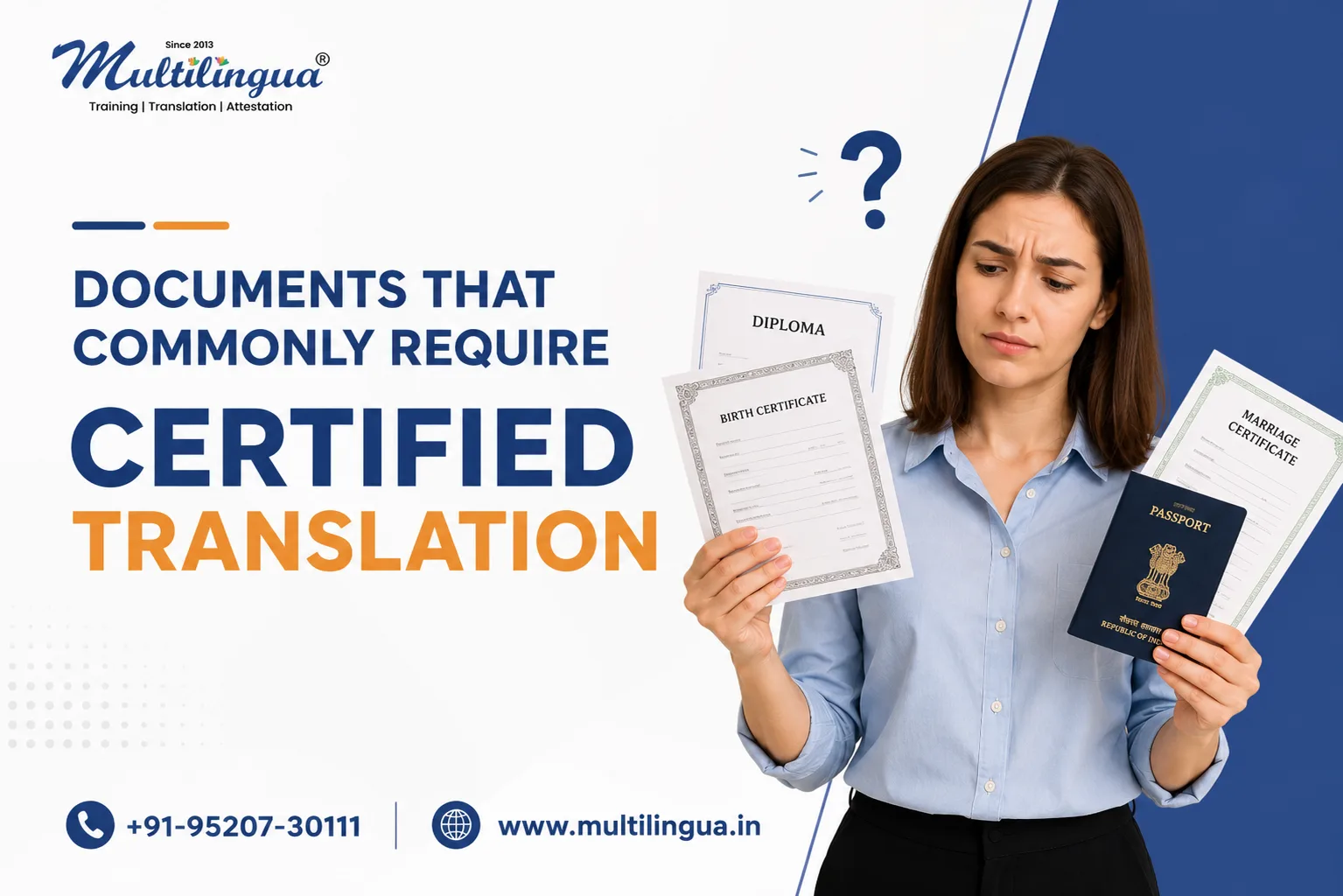
Top Documents That Commonly Require Certified Translation
Birth Certificates
Required for visa applications, passport renewals, school admissions, and citizenship applications. Immigration authorities and schools request these frequently, so names and dates must match the original exactly.
Marriage Certificates
Needed for spousal visas, name change procedures, and joint immigration applications. Couples applying for dependent visas almost always need this document translated and certified.
Divorce Decrees
Required when applying for remarriage documentation, custody proceedings, or updated visa status. Courts and immigration offices request these to confirm current marital status.
Death Certificates
Used in inheritance claims, insurance settlements, and pension transfers. Legal and financial institutions abroad typically require certified translation before processing claims.
Passports
Some countries require a certified translation of passport details when the original is not in a widely recognized language. This supports identity verification in visa and residency applications.
Driving Licenses
Needed when applying for a foreign driving license or exchanging an existing one. Transport authorities usually request a certified translation alongside the original license.
Police Clearance Certificates
A standard requirement for immigration and long-term visa applications. These confirm the absence of a criminal record and must be translated precisely, including official seals and reference numbers.
Educational Certificates
Covers school-leaving certificates and mark sheets used for admissions or credential evaluation abroad. Academic translation must preserve grading systems and subject names accurately.
Degree and Diploma Certificates
Universities and licensing boards request these for admissions, credential recognition, and professional registration. Institutions often specify formatting guidelines that a professional academic document translation service will follow.
Academic Transcripts
Detailed records of coursework and grades. These require careful handling of subject codes, credit hours, and grading scales that differ between education systems.
Employment Letters
Used for visa sponsorship, loan applications, and job verification abroad. Employers and immigration officers rely on these to confirm employment history and designation.
Salary Certificates
Frequently requested for visa financial proof or loan applications. Accuracy in currency figures and pay periods is essential.
Experience Certificates
Needed for skilled worker visas and professional licensing. These documents support claims of relevant work history in a new country.
Medical Reports
Required for visa medical examinations, insurance claims, and treatment abroad. Medical translation demands precision with clinical terminology.
Vaccination Records
Increasingly requested for travel, study, and immigration purposes. Accuracy in dates and vaccine names is critical for health authorities.
Bank Statements
Used as proof of funds for visa applications, admissions, and loan approvals. Numerical accuracy and consistent formatting are essential here.
Income Tax Documents
Requested for visa applications, financial audits, and business transactions abroad. Tax authorities and immigration offices scrutinize these closely.
Business Registration Certificates
Needed when a company expands internationally or enters new partnerships. Business document translation ensures legal recognition of the company’s status.
Contracts and Agreements
Cross border deals often require translated contracts for both parties to understand obligations clearly. Legal translation services ensure that clauses retain their original legal meaning.
Court Documents
Includes affidavits, judgments, and legal notices used in cross border litigation. These require precise legal terminology and are often the reason sworn translation is specifically requested.
Immigration Papers
Covers a wide range of forms submitted to immigration authorities. Immigration document translation must match official terminology used by the receiving country.
Visa Documents
Supporting paperwork for visa applications, including sponsorship letters and invitation letters. Visa document translation errors are a leading cause of processing delays.
Adoption Documents
Required for intercountry adoption processes. These involve sensitive personal information that must be translated with strict confidentiality.
Power of Attorney
Used when someone needs legal authority to act on another’s behalf across borders. Courts and financial institutions require certified translation to validate these documents.
Company Incorporation Documents
Necessary when registering a business abroad or opening international bank accounts. These documents establish the legal identity of a company in a new jurisdiction.
Who Needs Certified Translation Services?
Certified translation is not limited to one group of people. Students applying to universities abroad need academic document translation for transcripts and degrees. Skilled professionals require translated employment and experience certificates for work visas. PR applicants depend on certified translation for police clearance and civil documents.
Tourists occasionally need translated documents for extended stays or medical situations abroad. Families going through immigration, adoption, or marriage based visas rely heavily on certified civil documents. Businesses and exporters need translated contracts, incorporation papers, and compliance documents when entering foreign markets.
Lawyers handling cross border cases need sworn or certified legal translation for court admissibility. Healthcare providers treating international patients require translated medical histories and consent forms to deliver safe care.
When Is Certified Translation Mandatory?
Universities generally require certified academic translation as part of the admissions process, especially for degree evaluation. Immigration authorities almost always mandate certified translation for supporting civil documents like birth and marriage certificates.
Embassies frequently specify their own certification format for visa document translation, so applicants should check embassy specific guidelines. Courts require certified or sworn translation for any foreign language evidence or documentation submitted during proceedings.
Government departments handling passports, licenses, or benefits often require certified translation before processing applications. International employers may request certified translation of experience letters and educational qualifications during recruitment or background checks.
Common Reasons Documents Get Rejected
Missing certification is one of the most frequent issues. A translation without a signed accuracy statement is often treated as informal and unacceptable.
Incorrect names, especially transliteration mismatches between the original and translated document, can trigger rejection or additional scrutiny. Incomplete translation, where stamps, seals, or footnotes are skipped, also causes problems since institutions expect a full and faithful rendering of the source document.
Formatting errors, such as translations that do not mirror the layout of the original, can confuse reviewing officers. Machine translated documents almost always fail acceptance standards because they lack the certification and accuracy verification that official use demands. Using unqualified translators without recognized credentials is another common cause of rejection, particularly for legal and academic documents.
How to Choose the Best Translation Services
Look for native language experts who understand cultural and legal nuance, not just vocabulary. Confirm that the provider works with certified translators who can issue a valid accuracy statement.
Industry specialization matters, especially for legal, medical, or academic document translation, where terminology accuracy is essential. A strong quality assurance process, including proofreading and review by a second linguist, reduces the risk of costly errors.
Confidentiality should be non negotiable, particularly for documents containing personal, medical, or financial information. Turnaround time is another practical factor, especially when visa or admission deadlines are tight.
Transparent pricing helps avoid unexpected costs, and genuine customer reviews offer insight into reliability and accuracy. Finally, ask about data privacy practices to ensure your sensitive documents are stored and handled securely.
For a more detailed breakdown of these evaluation criteria, see this step-by-step guide to picking the right translation partner in Delhi, which covers experience, quality assurance, and turnaround time in more depth.
Why Work With a Professional Document Translation Agency?
A professional translation agency in Delhi typically has established relationships with the formatting and certification standards expected by embassies, universities, and government departments, which improves acceptance rates.
Beyond individual documents, the broader role translation plays in global business and cross-cultural communication explains why accuracy at the document level often has a direct impact on how organizations are perceived abroad.
Accuracy improves when translators specialize in the relevant subject matter, whether legal, medical, or academic. Legal compliance is easier to maintain when a provider understands the specific requirements of certified, notarized, and sworn translation across different jurisdictions.
Working with an established agency generally means faster processing through structured workflows and dedicated project management. Consistency across multiple documents matters for large applications, such as immigration files with many supporting papers. Reputable agencies also apply secure handling protocols for sensitive personal, legal, and financial documents.
If you are comparing providers, this resource on how to evaluate a professional translation services company offers additional questions worth asking before you commit to one.
Frequently Asked Questions
What documents require certified translation?
Civil documents like birth and marriage certificates, academic records, legal papers, immigration forms, and business documents most commonly require certified translation when submitted to official bodies.
Is certified translation legally valid?
Yes, when performed by a qualified translator and accompanied by a signed accuracy statement, certified translation is accepted as legally valid by most institutions, though requirements vary by country.
Who can certify a translated document?
A professional translator or a recognized translation agency can certify a document by signing a statement confirming accuracy and completeness.
How much do certified translation services cost?
Costs vary based on document type, language pair, length, and turnaround time. It is best to request a transparent quote before proceeding.
How long does certified translation take?
Standard documents like birth certificates often take one to two business days, while longer academic or legal documents may take longer depending on complexity and volume.
Do embassies accept online certified translations?
Many embassies accept digitally certified translations, but some require physical copies or additional notarization. Always verify with the specific embassy beforehand.
Is notarization the same as certification?
No. Certification confirms translation accuracy, while notarization verifies the identity of the person who signed the certification, performed by a notary public.
Can I translate my own documents?
Self translation is generally not accepted for official purposes because institutions require an independent, qualified translator to certify accuracy.
What is the difference between certified and professional translation?
Professional translation refers to quality work by a skilled linguist, while certified translation specifically includes a signed accuracy statement required for official submissions.
Which translation agency should I choose?
Choose an agency with certified translators, relevant industry experience, strong data privacy practices, transparent pricing, and a track record of successful embassy, university, or court acceptances.
Conclusion
Certified translation is not a formality. It is often the deciding factor between a smooth application and a frustrating rejection. Whether you need certified translation services in Delhi for a visa application, professional translation services for a business contract, or academic document translation for a university abroad, accuracy and proper certification make all the difference.
If you are preparing documents for an embassy, university, court, or employer, work with a document translation agency that understands the standards each institution expects. Our team offers certified translation services in Delhi, along with academic translation, immigration translation, business translation, and legal document translation, backed by strict confidentiality, quick turnaround, and personalized support for every client. Reach out today to discuss your documentation needs and get started with a translation you can trust.