
French is one of the most in-demand foreign languages in India right now, and Delhi has become a hub for people who want to learn it, whether that’s for higher studies abroad, a career move, or simply personal interest.
But with so many institutes, apps, and YouTube channels claiming to teach French “in 30 days,” it’s easy to feel confused about where to start. This guide breaks down what actually works, so you can choose the right path instead of wasting months on the wrong one.
Why Are So Many People in Delhi Learning French?
Delhi’s demand for French comes from a few clear directions. Students applying to universities in France, Canada, or Switzerland often need a recognized proficiency level (DELF/DALF) before they can apply. Professionals in aviation, hospitality, embassies, and export businesses need working French for day-to-day communication. And a growing number of people are simply learning it out of interest in the language and culture, or to add a second language to their resume in a competitive job market in French language.
Whatever the reason, the “best way” to learn French depends on your goal, your timeline, and how you learn best. Here’s how to think it through.
1. Get Clear on Your Goal Before You Choose a Method
Before picking an app, a tutor, or an institute, ask yourself what you actually need French for:
- Study abroad: You’ll likely need a DELF A2/B1 or B2 certificate, which means structured, exam-focused learning.
- Work: You may only need conversational fluency for specific contexts like customer service, travel, or aviation.
- Personal interest: You have more flexibility and can prioritize speaking and culture over grammar drills.
This single decision shapes everything else, because a self-paced app is fine for casual learners but rarely enough for someone who needs an internationally recognized certificate.
2. Why a Structured French Language Course in Delhi Works Better Than Self-Study Alone
Apps and free YouTube lessons are useful for building vocabulary, but French grammar (gendered nouns, verb conjugations, and sentence structures that don’t map directly to English) is genuinely difficult to self-correct. This is where a proper french language course in delhi makes a real difference. A structured classroom or live-online course gives you:
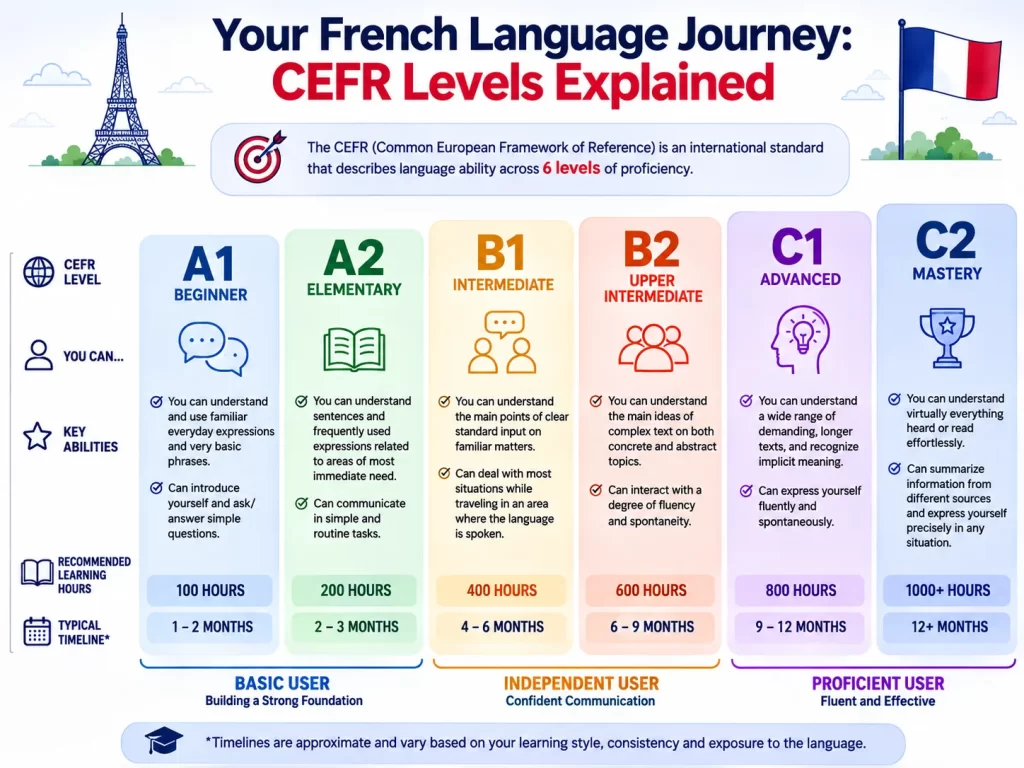
- A syllabus that follows the CEFR levels (A1 to C2) in order, so nothing important gets skipped
- A qualified instructor who can correct pronunciation and grammar mistakes in real time
- Regular speaking practice with classmates, which is nearly impossible to replicate solo
- A clear timeline toward a recognized certification like DELF or DALF
If your goal involves an exam, a visa application, or a job requirement, a french course in delhi with an experienced faculty and a defined curriculum is almost always the faster and more reliable route compared to piecing things together yourself.
3. What to Look for When Choosing French Classes in Delhi
Not all institutes are equal, and the difference shows up quickly once you’re a few weeks in. When comparing french classes delhi has to offer, look for:
- Qualified, native or near-native faculty with real teaching experience, not just fluency
- Small batch sizes so you actually get speaking time in every class
- CEFR-aligned curriculum that maps clearly to A1, A2, B1, and beyond
- DELF/DALF exam preparation built into the course, if certification matters to you
- Flexible formats, including weekday, weekend, and online batches for working professionals and students
- Transparent fee structure with no hidden costs for materials or exam registration
A good way to judge this before enrolling is to ask for a trial class. A single session tells you more about teaching quality than any brochure.
4. Combine Classroom Learning With Daily Practice
Even the best course only works if you reinforce it outside class. A few habits that genuinely move the needle:
- Listen daily: French podcasts, radio (RFI Savoirs is a solid beginner-friendly option), or French audio on streaming platforms
- Speak out loud, even alone: shadowing native speakers helps with accent and rhythm
- Read a little every day: simplified graded readers work better than jumping into a novel too early
- Use spaced-repetition apps like Anki alongside your course, not instead of it, to lock in vocabulary
Students who pair structured classes with 20-30 minutes of daily practice consistently progress faster than those who rely on twice-a-week classes alone.
5. How Long Does It Actually Take?
As a rough benchmark, most learners with regular classes and consistent practice reach:
- A1 (basic): 2-3 months
- A2 (elementary): 4-6 months
- B1 (intermediate, often the study-abroad benchmark): 8-12 months
- B2 (upper intermediate): 12-18 months
These timelines vary based on how many hours a week you commit and whether you’re practicing outside of class, but they’re a realistic starting point for planning around a visa deadline or exam date.
Frequently Asked Questions
1. Which is the best french language course in delhi for beginners?
Look for an institute that starts you at CEFR level A1 with small batch sizes and a native or near-native instructor. Beginners progress fastest when the course focuses on speaking practice from day one rather than just grammar theory.
2. How much does a french course in delhi typically cost?
Fees vary by institute and level, but most structured courses are priced per CEFR level (A1, A2, B1, and so on) rather than a single flat fee. It’s worth comparing what’s included, such as study material and DELF exam preparation, rather than comparing price alone.
3. Can I learn French online instead of attending french classes delhi has in person?
Yes, many institutes now offer live online batches that follow the same curriculum as in-person classes. Online works well if you’re consistent with attendance and practice, though in-person classes can offer more natural speaking opportunities.
4. Do I need to know French already to join a beginner course?
No, beginner batches assume zero prior knowledge and start from the French alphabet, basic greetings, and simple sentence structures before building up to conversation.
5. How long does it take to become conversational in French?
Most learners reach a comfortable conversational level (A2 to B1) within 6-12 months with regular classes and daily practice. This timeline shortens if you’re immersing yourself through listening and speaking practice outside class as well.
6. Is DELF certification necessary if I’m not planning to study abroad?
Not necessarily. DELF/DALF certification matters most for university admissions or certain visa and job applications. If you’re learning for personal interest or general workplace use, a course without exam-track certification is fine.
7. What is the difference between DELF and DALF?
DELF (Diplôme d’Études en Langue Française) covers levels A1 to B2, while DALF (Diplôme Approfondi de Langue Française) covers the advanced levels C1 and C2. Most learners in Delhi start with DELF and only pursue DALF if they need an advanced-level certificate for academic or professional purposes.
Final Thoughts
The best way to learn French in Delhi isn’t a single hack or app, it’s a combination of structured instruction, consistent practice, and a clear goal guiding your choices.
If you’re serious about reaching a certifiable level of fluency, whether for study, work, or personal growth, enrolling in a proper french language course in delhi with experienced faculty will get you there far more reliably than self-study alone.
Start with a trial class, ask about the curriculum and batch size, and choose an institute that treats your specific goal (exam, job, or travel) as the starting point for your learning plan, not an afterthought.