
Spanish is the second most spoken native language in the world, and for Indian learners it opens doors in tourism, hospitality, BPO and customer service roles, translation work, and study or migration opportunities across Latin America and Spain. If you are starting from zero and wondering how to learn Spanish without wasting months on the wrong method, this guide breaks down exactly what works.
There is no single best way to learn Spanish. What matters is matching a method to your goal, your available time, and how quickly you need results. Someone preparing for a job interview in three months needs a different plan than someone learning casually for travel. This guide covers both the self-study route and when a structured course makes more sense, so you can build a realistic plan instead of guessing.
Two things decide how fast you progress, no matter which method you choose: consistency and exposure. Twenty minutes of practice every day beats a three hour session once a week, because language learning depends on repetition reinforcing memory, not on cramming. And the more Spanish you hear, read, and speak in everyday life, the faster new vocabulary and grammar patterns stick.
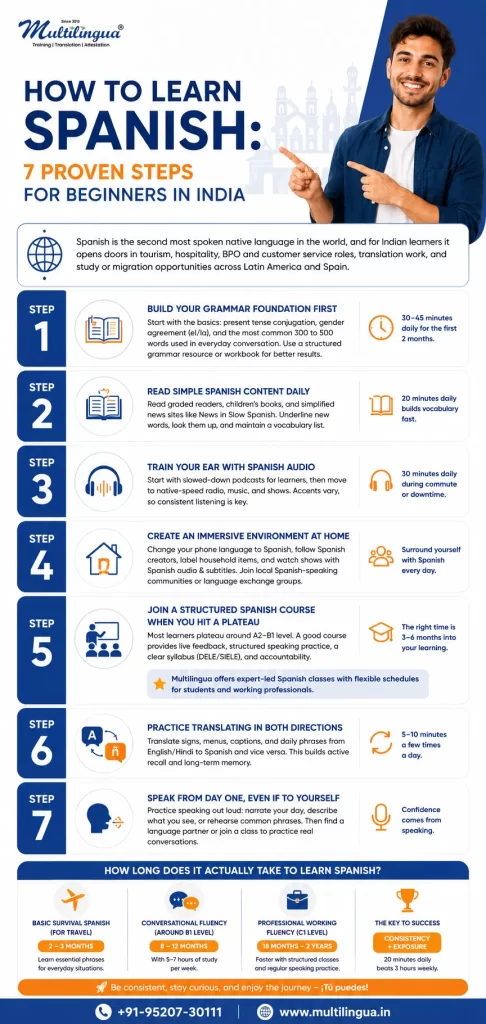
1. Build your grammar foundation first
Start with the basics: present tense conjugation, gender agreement (el/la), and the most common 300 to 500 words used in everyday conversation. A structured grammar resource or workbook works better than jumping between random YouTube videos, because it builds concepts in order instead of leaving gaps.
Set aside 30 to 45 minutes a day for this in your first two months. Keep a small notebook for verb conjugations and phrases that trip you up, and review it weekly. This single habit prevents the most common beginner problem: forgetting basic grammar rules months later because they were never reinforced.
2. Read simple Spanish content daily
Reading builds vocabulary faster than almost any other method, because you see words in context rather than as isolated flashcards. Start with graded readers or children’s books written specifically for Spanish learners, then move to simplified news sites like News in Slow Spanish once you are comfortable with basic sentence structure.
Underline unfamiliar words, look them up, and keep a running vocabulary list. Reading for 20 minutes daily for the first six months builds a working vocabulary far faster than passive listening alone.
3. Train your ear with Spanish audio
Listening comprehension is usually the hardest skill for beginners, because spoken Spanish moves faster than textbook audio and accents vary widely between Spain and Latin America. Start with slowed-down podcasts designed for learners, then gradually move to native-speed radio, music, and shows once you can follow basic conversations.
A useful target: 30 minutes of listening practice a day during your commute or downtime. It will feel difficult for the first few months. That is normal and expected, not a sign you are doing something wrong.
4. Create an immersive environment at home
You do not need to move to Spain or Latin America to immerse yourself in the language. Change your phone’s display language to Spanish, follow Spanish-language creators on social media, label objects around your house with their Spanish names, and watch shows with Spanish audio and subtitles.
If you live in Delhi or another Indian city, look for local Spanish-speaking communities, language exchange meetups, or conversation circles. Many cities now have informal exchange groups where you can practice with both native speakers and fellow learners.
5. Join a structured Spanish course when you hit a plateau
Self-study works well for building vocabulary and grammar, but most learners hit a plateau around the three to six month mark, usually around the A2 to B1 level, where progress slows and speaking confidence stalls without real conversation practice. This is the point where a structured course makes the biggest difference, not at the very beginning.
A good course gives you four things self-study struggles to replicate: live correction of pronunciation and grammar mistakes, structured speaking practice with feedback, a clear syllabus mapped to recognized levels like DELE or SIELE, and accountability that keeps you consistent when motivation dips.
At Multilingua, Spanish classes are taught by qualified instructors with flexible scheduling, so working professionals and students can fit lessons around existing commitments. If you have been self-studying for a few months and feel stuck, this is usually the right time to enroll rather than waiting longer.
6. Practice translating in both directions
Once you have basic vocabulary down, practice translating everyday things you encounter, signs, menus, social media captions, into Spanish in your head. This forces active recall rather than passive recognition, which is a much stronger memory trigger.
Do this for five to ten minutes a few times a day rather than as one long session. Over time you will notice yourself thinking in Spanish phrases without consciously translating, which is the real marker of progress.
7. Speak from day one, even if it is just to yourself
Most spanish beginners delay speaking practice until they feel ready, but confidence comes from speaking, not the other way around. If you do not have a conversation partner yet, practice speaking out loud to yourself: narrate your day, describe what you see, or rehearse common phrases in front of a mirror.
This removes the fear of making mistakes in front of others and builds the muscle memory needed for real conversations later. Once you have a few weeks of this under your belt, look for a language exchange partner or join a class where speaking practice is built into every session.
How long does it actually take to learn Spanish?
For an English or Hindi speaker studying consistently (around 5 to 7 hours a week), reaching conversational fluency (roughly B1 level) typically takes 8 to 12 months. Basic survival Spanish for travel can be picked up in 2 to 3 months. Professional working fluency (C1 level) generally takes 18 months to 2 years of consistent study, often faster with structured classroom instruction and regular speaking practice.
Frequently Asked Questions
Can I learn Spanish without joining a course?
Yes, for the basics. Self-study works well for building vocabulary, grammar, and listening skills up to a beginner to intermediate level. Most learners eventually join a structured course to push past the early plateau and build real speaking confidence with feedback.
Is Spanish hard to learn for Hindi or English speakers?
Spanish is considered one of the easier languages for English speakers to learn, since it shares Latin-based vocabulary with English and has consistent, phonetic pronunciation rules. Hindi speakers often find the grammar gender system (el/la) and verb conjugation patterns the trickiest part initially.
What is the fastest way to learn Spanish?
Combining daily structured study with regular speaking practice is faster than any single method alone. Learners who study with a tutor or course while also practicing listening and speaking daily on their own tend to progress two to three times faster than those relying on either method in isolation.
Should I learn Spanish from Spain or Latin America?
For most Indian language learners, the difference matters less than people assume, since the core grammar and vocabulary overlap significantly. Choose based on your goal: Latin American Spanish for travel or work in Mexico and South America, European Spanish if you are targeting Spain specifically for study or work visas.
Final thoughts
There is no shortcut that replaces consistency. Whether you choose self-study, a structured course, or a mix of both, the learners who succeed are the ones who show up daily, even for short sessions, and create regular opportunities to actually use the language rather than just study it.
If you have been learning on your own and feel stuck, or want a clear path toward conversational fluency with expert guidance, Multilingua‘s Spanish courses are designed to take you from beginner to confident speaker with structured lessons and flexible scheduling.